Showing posts with label Technical Lesson. Show all posts

Thursday, December 12, 2013

Intraday Analysis Update Wed Dec - 11

Intraday Markets

Could USA oil supplies data cause WTI oil to flirt with the critical $100 a barrel level?

Wednesday sees the publication of USA oil supplies data, expected to print at -5.6 bn barrels, whilst the USA federal budget balance is expected to print at $154.6 bn, significantly worsening from the previous month's figure of $91.6 bn. In New Zealand the cash rate is announced, predicted to stay the same at 2.5%. The press conference, the rate statement and the policy statement will accompany the announcement of the base interest rate, finally later that evening the RBNZ governor Wheeler will conduct a conference.
see more at : Intraday Analysis Update Wed Dec - 11

Disclaimer The analysis we provide is based on the average estimate of price movements in one day. Does not guarantee what we deliver is actually a proper and correct. Everything that happens in the decisions you make on your trading transaction is to be Your responsibilities.

Wednesday, December 11, 2013

EUR / CHF - Tue Dec 10 - Get your Entry Levels, Stop Loss and Take Profit Targets now!

EURCHF grinds at Support
Timeframe: D1 Recommendation: Long Positionsee more at :

Disclaimer The analysis we provide is based on the average estimate of price movements in one day. Does not guarantee what we deliver is actually a proper and correct. Everything that happens in the decisions you make on your trading transaction is to be Your responsibilities.

Thursday, June 6, 2013

PAXFOREX : USDCHF Support Zone


USDCHF Support Zone

The USDCHF has contracted after reaching a multi-month high as visible in this D1 chart. USDCHF bulls have called for a rally to test the 1.000 level, but this currency pair has corrected sharply and the drop was halted by this currency pair’s 50 DMA which also enforces the upper band of the support zone. The last two daily candlestick formations have formed an inverted hammer as well as hammer formation at support which is a bullish indicator. We expect this pair to stabilize within its support zone which sees its lower band enforced by its 200 DMA.
MACD has contracted, but remains in bullish territory. The sharp contraction caused a gap to form between the moving average and the histogram which we believe will be closed during the pending move higher and we do expect it to remain in bullish territory overall. RSI has contracted from extreme overboughtconditions to neutral territory and may not collapse into oversold territory.
We recommend a long position at 0.9470 with a potential second entry level at 0.9370. We also recommend a stop sell order at 0.9400 in order to hedge the initial long position.
Traders who wish to exit this trade at a loss are advised to place their stop loss order at 0.9400. We will not use a stop loss order for this trade and will execute this trade as recommended. Place your take profit level at 0.9670.
Here are the reasons we call the USDCHF currency pair higher
  • USDCHF has corrected sharply from recent highs and the drop was halted by the upper band of its support zone
  • The upper band of its support zone is enforced by this currency pair’s 50 DMA
  • The lower band of its support zone is enforced by this currency pair’s 200 DMA and we believe this currency pair will stabilize in the support zone given the overall strength of the zone
  • A short covering rally in order to lock in profits before Friday’s U.S. employment snapshot for May
  • Bargain hunters who seek to take advantage of the support zone


Disclaimer The analysis we provide is based on the average estimate of price movements in one day. Does not guarantee what we deliver is actually a proper and correct. Everything that happens in the decisions you make on your trading transaction is to be Your responsibilities. Flag Counter Visit Us www.deryworldscorp.web.id Visit Us www.deryworldscorp.asia

Tuesday, June 4, 2013

MAYZUS : Dollar Smoked After ISM


The market is hooked on the whims of US economic data with Fed tapering on the horizon. A soft ISM manufacturing reading Monday crushed the US dollar. Meanwhile, the Australian dollar had its best day of 2013, climbing nearly 200 pips ahead of today's RBA decision. Ashraf is on travel in the MidEast. A new edition of the Premium Insights will be released on Tuesday. EURUSD and 1 of USDJPY were stopped out, 1 of 3 AUDUSD are in progress.
The USD/JPY bulls were wavering ahead of the ISM manufacturing PMI and they cracked when the numbers were released. The index fell to 49.0 which is in contractionary territory for the first time since November and below the 50.7 expected.
The miss in the data was sizable but not incredible but it didn't matter to the market. Traders had grown overwhelmingly long the US dollar in May and everyone seemingly rushed for the exits at the same time. USD/JPY broke below 100 and then 99 to as low as 98.87.
Other USD moves were also dramatic. EUR/USD, which slumped to 1.2956 ahead of the data whipsawed traders and rallied to 1.3100. The Canadian dollar posted its best gain in a year with USD/CAD falling a fell cent to 1.0276.
Late in the day, USD/JPY and other pairs retraced some of the moves after a Reuters story suggested Japan's public pension could be planning to shift investments to riskier and foreign assets. In addition, a late gain in the S&P 500 sparked some USD buying.
The most impressive move of the day was in the Australian dollar, as it climbed two cents to as high as 0.9792. The RBA interest rate decision is at 0430 GMT and will be the highlight of the session. The statement after last month's cut didn't indicate that further cuts were imminent so expectations are low for any change.
Instead, the focus will be on comments about investment, the domestic economy and the Australian dollar. Any indications about further cuts could quickly reverse Monday's AUD gains.
by Adam Button


Disclaimer The analysis we provide is based on the average estimate of price movements in one day. Does not guarantee what we deliver is actually a proper and correct. Everything that happens in the decisions you make on your trading transaction is to be Your responsibilities. Flag Counter Visit Us www.deryworldscorp.web.id Visit Us www.deryworldscorp.asia

Monday, June 3, 2013

FXPRO : Fed to taper in 2013


The European Central Bank has been more outspoken about the possibility of setting a negative deposit rate, but this does not come without complications. The whole system is based on the ECB paying banks, not the other way around Simon Smith of FxPro. 
In the interview below, Smith also assesses that the Fed will taper QE this year, and explains the drivers behind such a move. In addition discusses the prospects of more Aussie weakness, policies of Japan towards the upper house elections and future BOE policy. A lot of food for the thought.
Simon has ovFxPro in May 2010, Simon was a consultant with Thomson Reuters, having spent four years as Chief Economist at Weavering Capital. He has held economic and strategy positions with Standard & Poor’s, together with consultancy firms 4Cast and MMS International. Simon holds an MSc. in Economics from the University of London and a BSc. from Brunel University.
er seventeen years experience of macro forecasting and investment strategy research. Prior to joining 
  1. Do you think that the ECB will cut the lending rate or set a negative deposit rate in the upcoming meeting?
I think it’s unlikely that we will see anything.  They cut the lending rate only last month to 0.50% and Draghi did sound a little more open to the idea of a negative deposit rate. During normal times, any banks putting any excess money on deposit at the ECB (rather than lending to other banks) receive 1% below the main lending rate.  This provides meant as a ‘penalty’ for doing so.  But the difference is now only 0.5%, so the penalty has been halved.  But adopting a negative deposit rate is not without its problems.
The whole system is based on the ECB paying banks, not the other way around, so there are logistical considerations. Beyond that, we have to see who will be punished. The risk is that the burden falls on better capitalised banks, who could be encouraged to park funds overseas.  But what’s notable is that the amount being put on deposit at the ECB continues to fall, by more than 66% since the start of the year.  Whilst this trend continues, the impact of a negative deposit rate falls the longer the ECB waits.
I still think there is a decent chance it will happen, but just not as early as June.
  1. The QE tapering topic has been a significant driver of the US dollar. Do you think that the Federal Reserve could indeed lower the pace of bond buys this year? What level of monthly job gains is needed for this?
    The Fed will taper bond purchases this year.  Furthermore, the minutes have told us that the labour market will be a fairly key factor in determining when the pace of purchases are scaled back, but they have not set any numbers on this, in contrast to their pledge for an “exceptionally low range for the federal fund rate” whilst unemployment is above 6.5%.  I would think they would like to see monthly growth in headline payrolls of 200k. We are at that on the 3 and 6 month averages, but only just and the last 2 months have been below this. As such, they want to be sure that the recovery is sustainable. Too often policy makers (and even more often markets) have been caught out, expecting that the worst is over, only for expectations to see a strong turnaround, either on the back of unexpected events or otherwise.
  1. In Japan, elections for the upper house of parliament are scheduled for July 21st. Can we expect the government to introduce more plans towards the elections, or will they try not to change anything now that Abenomics is perceived as a success story?
Notionally you would have thought they would hold back on some of the more difficult structural reforms as part of their growth strategy, because they are likely to be electorally unpopular.  There will still be an element of this, but in general Abe has shown a strong willingness to push ahead, understanding that structural reforms are required if Japan is to stand any chance of achieving the growth required to pay off the debt it has accumulated over the years.  Abe has strong approval ratings and the LDP are seen doing well in July, which will give him a stronger mandate to push through such reforms.  So in summary, I think it’s going to be a balancing act, doing enough to show progress, but not so much that their solid electoral chances are jeopardised.
  1. The Australian dollar received many negative headlines of late. Is this negativity in place, or has the market gotten ahead of itself?
In the middle of the month, I certainly had the sense that the Aussie was looking over-sold, given the extent of the sell-off seen. But more recently it has turned into a US dollar story, with the greenback strong pretty much across the board and this has caused more investors to bail-out of long-term positions on the Aussie. This time last year, it was very much a story of relative sovereign fundamentals. The Eurozone crisis was deepening, there were doubts over US budgetary policy and the Aussie was benefitting from (among other things) the perception that its public finances were on a much sounder footing. The Eurozone position has improved (or at least markets are pricing this) and the US battled through the sequester. There have always been reasons to say the Aussie has been overvalued for the past several years, but it’s all a matter of timing and momentum. For now, the timing is right for a weaker Aussie and the momentum has been in place in May. There remains a risk of a modest correction, but overall the trend towards a weaker is likely to continue in the second half of the year.
  1. The Bank of England is currently in twilight zone. Looking forward to Carney’s first rate decision in July, do you see any big moves?
Not for the moment.  Looking at the performance of the majors during May, Sterling is the first currency that has more been a victim of the firmer dollar environment, rather than a cause. In other  words, the yen, Aussie and kiwi have all had their reasons for weakening, whereas sterling has not had been subject to domestic factors pushing it lower.  The fact that we heading into a transition at the Bank of England has probably been playing a part in this, together with the fact that we are seeing some signs of stabilisation on the economy, meaning more divided opinions on the MPC between those believe the UK needs more QE (3 members voting for this over recent months) and those who believe it does not.  I don’t see any moves straight away on UK policy. Statistically, meetings 1 month before at Inflation Report (released every 3 months, including August) are the least likely to result in a change of policy, as the committee holds back to update their latest thinking. I think we will see more QE, but not straight away.


Disclaimer The analysis we provide is based on the average estimate of price movements in one day. Does not guarantee what we deliver is actually a proper and correct. Everything that happens in the decisions you make on your trading transaction is to be Your responsibilities. Flag Counter Visit Us www.deryworldscorp.web.id Visit Us www.deryworldscorp.asia

USD Leads May Despite Last 3 Days


by Adam Button
Jun 3, 2013 0:21
A strong official PMI from China contrasted a weak reading on the sector from HSBC. Despite a three day slump to end the month, the US dollar was easily the best performer in May while the Australian dollar lagged badly. Weekly CFTC positioning data show growing AUD and CHF shorts. We reintroduced USDCHF after a long absence from the Premium Insights with 2 new trades and monthly and weekly charts. 1 EURUSD remain in progress as well as 3 USDJPY, 2 EURJPY, 2 USDCAD and 1 silver. For full detail, see latest Premium Insights.
The official manufacutring sentiment survey from China rose to 50.8 compared to 50.0 expected and 50.6 in April. The number could give the Australian dollar some respite to start the week but traders may be skeptical. The PMI earlier in the week from HSBC slipped to 49.6 from 50.4 in April.
There is also uncertainty about the US manufacturing. Signs were pointing to a worsening slump until Fridaywhen the Chicago PMI soared to 58.7 compared to 50.0 expected. In the span of a month, the index when from the lowest since 2009 to the highest since early 2012.
We caution that it's only one month and one data point but renewed strength from US factories would be another reason to buy the US dollar. The other data point on Friday was the PCE report, which showed core inflation up 1.1% compared to 1.0% y/y expected. Rising inflation could give the Fed an incentive to taper QE, which could be a major boost for the US dollar. One negative part of the report was personal spending, which fell 0.2% in April.   Commitments of Traders
Speculative net futures trader positions as of the close on Tuesday. Net short denoted by - long by +.
EUR -85K vs -81K prior JPY -100K vs -95K prior GBP -75K vs -77K prior AUD -42K vs -32K prior CAD -33K vs -34K prior NZD +14K vs +18K prior CHF -29K vs -20K prior US Dollar Index longs at 46K vs 43K prior
The market has quietly built up the largest short position in CHF in 11 months. There are always rumors about hiking the EUR/CHF floor but it's mostly a trade on dollar strength and improving fundamentals in Europe.
Meanwhile, euro shorts are showing no sign of quitting even though more than half of the short position was initiate in the past two weeks – all of which are underwater. It's also interesting to note the lack of movement in NZD despite the rush in Australian dollar shorts. The carry is better in New Zealand but it's difficult to imagine the divergence continuing.


Disclaimer The analysis we provide is based on the average estimate of price movements in one day. Does not guarantee what we deliver is actually a proper and correct. Everything that happens in the decisions you make on your trading transaction is to be Your responsibilities. Flag Counter Visit Us www.deryworldscorp.web.id Visit Us www.deryworldscorp.asia

Friday, May 31, 2013

XEMARKETS EURJPY ON JAPAN CPI FRIDAY 31.05.2013


What a difference a day makes as today's USD tumble was attributed to a modest miss in Q1 GDP revision (2.4% vs exp 2.5%), while the important PCE rose to a higher than expected 3.4%. USDX failed to reach the 85 resistance, but support looks to remain intact around 80.70. AUDUSD rebounded on higher than expected Capex spending plans but failed to reach our 0.9700 short. EUR and CHF were among the day's best performers. Tonight's April CPI figures (00:30 London) from Japan are expected to show improved data all around, which may justify the weak-yen policy and support yen crosses. With EUR outperforming most major FX lately, EURJPY will be particulat to watch as Japan's inflation data is released amid 13-month highs in JGB yields.  CAD awaits tomorrow's March GDP figures, which will help determined the fate of our latest USDCAD longs.
by Ashraf Laidi
May 30, 2013 20:38


Disclaimer The analysis we provide is based on the average estimate of price movements in one day. Does not guarantee what we deliver is actually a proper and correct. Everything that happens in the decisions you make on your trading transaction is to be Your responsibilities. Flag Counter Visit Us www.deryworldscorp.web.id Visit Us www.deryworldscorp.asia

Thursday, May 30, 2013

FXCC : MARKET UPDATE 30.05.2013

FXCC Forex Trading

2013-05-30 04:30 GMT
OECD: Global economy is moving forward at multiple speeds
In its biannual Economic Outlook report, published on Wednesday, the Organization for Economic Cooperation and Development reduced the global growth outlook to 3.1% from the previous estimate of 3.4%. It expects the US and the Japanese economies to improve this year, suggesting at the same time that the Eurozone will continue to lag which might have “negative implications for the global economy."
The OECD cut the Eurozone growth forecast to -0.6% from -0.1% estimated in November 2012, warning that "activity is still falling, reflecting ongoing fiscal consolidation, weak confidence and tight credit conditions, especially in the periphery." The Eurozone economy should rebound to 1.1% in 2014. The OECD also urged the ECB to seriously consider implementing QE and introducing negative deposit rates in order to stimulate recovery in the area. China, which already saw its growth outlook reduced on Tuesday by the IMF, is expected to grow by 7.8% this year, down from a previous estimate of 8.5%. The organization was more upbeat about the US, which is projected to grow by 1.9% in 2013 and by 2.8% in 2014. Japan's growth forecast was hiked to 1.6% from 0.7%, with the prospect of a 1.4% gain next year, owing to the BoJ's implementation of fiscal and monetary stimulus programs.-FXstreet.com


2013-05-30 06:00 GMT
UK. Nationwide Housing Prices n.s.a (YoY) (May)
2013-05-30 12:30 GMT
USA. Gross Domestic Product Price Index
2013-05-30 14:30 GMT
USA. Pending Home Sales (YoY) (Apr)
2013-05-30 23:30 GMT
Japan. National Consumer Price Index (YoY) (Apr)
http://bit.ly/FXCC_Deryworldscorphttp://bit.ly/FXCC_Deryworldscorp
 
2013-05-30 04:39 GMT
USD eases to key level at 83.50 ahead of US GDP
2013-05-30 03:11 GMT
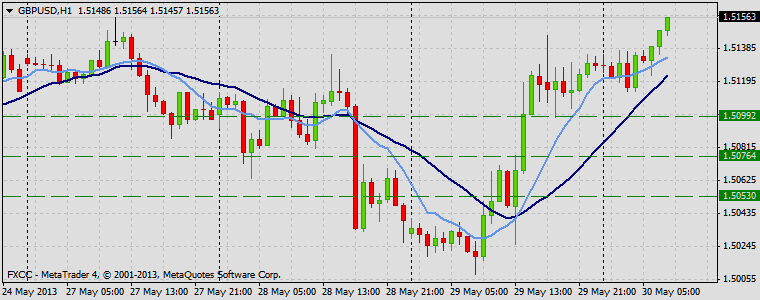
GBP/USD – Bullish engulfing candle to spur further advances?
2013-05-30 02:29 GMT
EUR/USD edging towards resistance at 1.3000
2013-05-30 01:50 GMT
Aussie edging higher towards resistance at 0.9700
AUDUSD
0.96915 / 920
NZDUSD
0.81185 / 197
USDCHF
0.95677 / 683
USDCAD
1.03311 / 318
GBPJPY
152.780 / 796
EURCHF
1.24228 / 233
GOLD
1404.99 / .05
SILVER
22.59 / .63
 
EURUSDHIGH1.2975LOW1.29332BID1.29729ASK1.29729CHANGE0.26%TIME08:23:33
OUTLOOK SUMMARY
Up
TREND CONDITION
Upward
penetration
TRADERS SENTIMENT
Bearish
IMPLIED VOLATILITY
High
MARKET ANALYSIS - Intraday Analysis
Upwards scenario: Recent upside penetration is limited now to the key resistive barrier at 1.2977 (R1). Appreciation above this mark might likely push the pair toward to next targets at 1.2991 (R2) and 1.3006 (R3) in potential. Downwards scenario: Possible bull back on the hourly chart might face next hurdle at 1.2933 (S1). Break here is required to open road towards to our next retracement target at 1.2919 (S2) en route to final aim at 1.2902 (S3).
Resistance Levels: 1.2977, 1.2991, 1.3006
Support Levels: 1.2933, 1.2919, 1.2902
GBPUSDHIGH1.51713LOW1.51136BID1.51673ASK1.51681CHANGE0.26%TIME08:23:34
OUTLOOK SUMMARY
Up
TREND CONDITION
Upward
penetration
TRADERS SENTIMENT
Bullish
IMPLIED VOLATILITY
High
Upwards scenario: A bullish oriented market participant might pressures to test our next resistance level at 1.5165 (R1). Loss here could open a route towards to our interim target at 1.5188 (R2) and the main aim for today locates at 1.5211 (R3). Downwards scenario: As long as price stays below the moving averages our medium-term outlook would be negative. Though, extension lower the 1.5099 (S1) is being able to drive market price towards to our next supports at 1.5076 (S2) and 1.5053 (S3).
Resistance Levels: 1.5165, 1.5188, 1.5211
Support Levels: 1.5099, 1.5076, 1.5053
USDJPYHIGH101.538LOW100.592BID100.803ASK100.807CHANGE-0.34%TIME08:23:35
OUTLOOK SUMMARY
Down
TREND CONDITION
Downward
penetration
TRADERS SENTIMENT
Bullish
IMPLIED VOLATILITY
Medium
Upwards scenario: USDJPY recently tested negative side and currently remains stable below the 20 SMA. Possible price appreciation is limited to the resistance level at 101.53 (R1). Only clear break here would suggest next intraday targets at 101.81 (R2) and 102.09 (R3). Downwards scenario: Any prolonged movement below the support at 100.60 (S1) might prolong downside pressure and drive market price towards to supportive means at 100.34 (S2) and 100.08 (S3).
Resistance Levels: 101.53, 101.81, 102.09
Support Levels: 100.60, 100.34, 100.08


Disclaimer The analysis we provide is based on the average estimate of price movements in one day. Does not guarantee what we deliver is actually a proper and correct. Everything that happens in the decisions you make on your trading transaction is to be Your responsibilities. Flag Counter Visit Us www.deryworldscorp.web.id Visit Us www.deryworldscorp.asia

EUR/USD Technical Analysis


EUR/USD Technical Analysis

| Wednesday, 29 May 2013 21:08

EUR/USD inched closer to 1.30 on Wednesday following strong CPI data from Germany. The pair has consolidated in the mid-129 region following the close of European markets. With no key economic releases slated for Wednesday, the pair is likely to hold steady in North American trade. Below we survey the market vitals for this pair and where we expect it to go this week.
EUR/USD Performance Tracker
5-Day: +0.15%
Outlook: Slightly bullish
Pivot: 1.2954
Support levels: 1.2942, 1.2934, 1.2921
Resistance levels: 1.2967, 1.2974, 1.2987
Movement for this pair could pick up over the next two days, as the US is set to release a few key economic indicators. Traders should keep the following releases in mind:
Thursday:
  • Weekly job claims
  • GDP revision
  • Pending home sales
Friday:
  • Personal income
  • Consumer spending
  • Chicago PMO
  • Consumer sentiment
The euro continues to hold steady, despite a mixed bag of German data (high unemployment balance strong CPI). The EUR/USD pair continues to be drawn to the 1.30 line, which most believe is fair value for the time being. On Wednesday the euro gained on the back of investor profit-seeking at the expense of the US dollar.
The euro continues to outperform its other major competitors, signalling a slightly bullish market for key euro pairs. Below is a summary:
EUR/GBP: 0.8561 (+0.1300%)
EUR/CAD: 1.34 (+0.3400%)
EUR/AUD: 1.34 (+0.4600%)
The only blip was the volatile yen market, which pushed EUR/JPY back to 1.3065 rang—a drop of 0.6100% on the day.


Disclaimer The analysis we provide is based on the average estimate of price movements in one day. Does not guarantee what we deliver is actually a proper and correct. Everything that happens in the decisions you make on your trading transaction is to be Your responsibilities. Flag Counter Visit Us www.deryworldscorp.web.id Visit Us www.deryworldscorp.asia

Followers


Flag Counter

Subscribe via email

Enter your email address:

Delivered by FeedBurner