Showing posts with label E-Book. Show all posts

Saturday, July 21, 2012

Tom DemarkTrend Lines


Tom DemarkTrend Lines


Trend lines are universally used by almost all traders.  They are a common place for all traders to begin their technical analysis.  The problem is that a trader becomes too subjective in their trend line drawing.  Many traders will draw on separate occasions two totally different trend lines based on the identical information, depending on his inclination each time, thus consistency and uniformity are totally lacking.  Not all trend lines are correct, in the end only one is.  Throughout exhaustive research, I have arrived at an effective method to select the points essential to the proper construction of a trend line.  Once learned and applied, trend line analysis is no longer subjective, it becomes completely mechanical.  Trend line breakouts are precisely defined and price projections can easily be calculated. 

Supply and demand create price movement.  Specifically, should supply exceed demand, price declines; conversely should demand exceed supply, price advances.  This is the basic economic theory accepted by all traders that creates the market.  In order to illustrate this we construct an ascending line to represent demand and a descending line to represent supply.  The difficulty in constructing trend lines becomes apparent when choosing the specific points to select and connect creating the trend line.  As in many aspects of trading, human nature tends to interfere greatly in the proper construction of trend lines.

The first major error traders posses when creating trend lines is working from past to present, in other words working from left to right on the chart in their construction of the trend line.  This is incorrect, for this reason alone; recent price activity is more significant than historical price activity.  After all, the forex market is the most dynamic market in the world, meaning it is changing all the time.  This approach will seem unorthodox to most trader at first, but in actuality, this is the number one mistake that traders make when creating trend lines.  We are accustomed from children to read everything from left to right, correct?  When drawing trend lines we must learn to read like the Japanese do, from right to left.  Success in creating trend lines requires both an attention to detail and a pattern of consistency.   Imprecision and disregard for detail are the common practice in creating trend lines, which will result in the construction of multiple trend lines forcing the trader to hope one of the trend lines will correctly define the trend.

The first step to trend line construction, and most important, is the selection of the two points to create the trend line with.  As I stated above, when pursuing to construct a trend line we must read like the Japanese, from right to left.  All trend line analysis will be done on the four hour chart compression.  By process of elimination of all chart compressions, I have concluded that only the four hour compression is needed.  The four hour compression generates less trend line breaks and more accurate price projections than any other time compression.  All analysis shown of trend lines will be conducted of the four hour compression.


In order to create a trend line, it is necessary to locate the two points to create the trend line.  In this example we will be talking about a demand trend line (uptrend).  An uptrend is created when demand exceeds supply; this is where the name demand line is derived from.  When choosing the points to create a demand line we are focusing on points of support.  True points of support are only those which low has two candles to the left of it and two candles to the right of it which lows do not exceed the low you are using. See the examples below for reference of true support points.
      

In the chart above, I have marked the two points that will be used to create the demand line, remember only two points are used to create our trend lines.  Notice how I refer to the most recent point of support on the chart as the 1st point, remember we trade the most dynamic market in the world, right to left is the key.  To find the second point of the demand line we look for the very next point of support that has two candles to the left and two to the right that do not exceed the low of the support point. 


Once we have created of trend line, our next step is to use this trend line to create a downside price projection once the market opens a candle on the four hour chart below the demand line.  Note I only say once the market opens a candle, mentioned nothing about close because only the open of a candle is necessary to create the price projection.   The price projection is created this way; you take the highest high created above the demand line and mark it with a vertical line. As pictured in the example below:
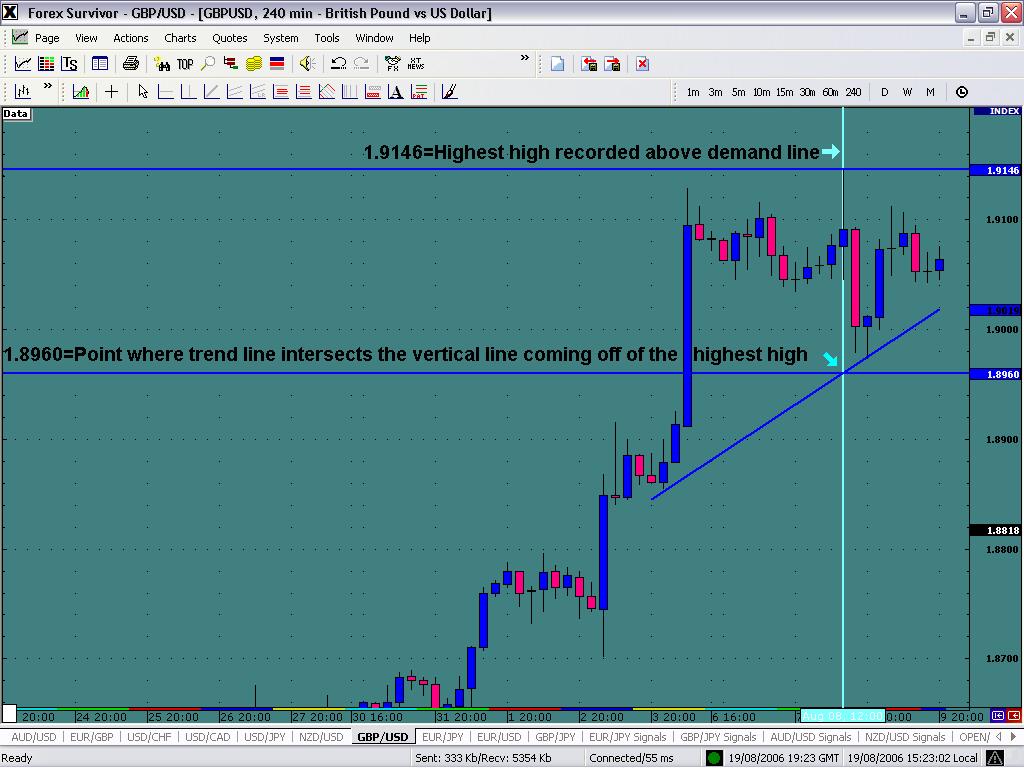


Next you need to take a horizontal line and mark the point where the vertical line coming from the highest high recorded above the trend line intersect with the trend line.  What seems complicated at first will be much easier observed and understood in the example below.


Note the two values listed on the chart.  In the next step we take the difference between the highest high recorded above the demand line and the point where the demand line is intersected by the vertical line. 

Highest High                1.9146
                                  -
Point of intersection     1.8960
                                      0.0186

We get a difference of 186 pips. This number becomes our price projection.  The final step in the process is the point of application of the price projection.  The price projection will be 186 pips to the downside once a four hour candle has opened below the demand line.  It is key to become accustomed to this technique because price usually reacts quickly to the downside once a candle has opened beneath the demand line.  Valuable pips will be lost if the trader does not react quickly in many cases. 


The price projection is made at the open of the first candle to open below the demand line. For visual reasons above the candle has closed also, but the price projection should be projected immediately following the open of the candle.  Remember, we don’t need the candle to open and close below the demand line in order to make our price projection, only the open is needed.  Above in the example, we have an open value of the first candle below the demand line at 1.9010. From this value we will subtract the 186 pip difference we got from step 2. 

Open below demand line        1.9010
                                            -
Difference from Step #2         0.0186 
                                                1.8824

1.8824 becomes our price projection to the downside from the open of 1.9010.  This is a 186 pip potential trade.


Notice the price projection marked at the bottom of the page. The line was place 186 pips below the open of the first candle below the demand line. Let’s see the trade just one candle after entry. 


Note the rapid decline in the value of the currency once it breaks the demand line.  Let’s see if it reaches the full price projection.

Notice how price fulfilled the 186 pip price projection.  What may seem at first to be a complicated task, once reviewed and practiced by traders becomes a very easy and profitable way to trade.  Trend line projections give the trader the best overall view of where the market will be going.  In the above examples we have discussed demand lines and the downside price projections once the demand line is broken.  In the next section we will discuss supply lines and the upside projections that are created from supply line breaks.  The same technique is used in both instances except you are using know a supply line instead of a demand line and you will be projecting a upside breakout instead of a downside breakout.

In order to create a supply line, it is necessary to locate the two points that create the supply line.  Remember that a supply line is the same thing as a down trend line.  A supply is created when supply exceeds demand; this is where the name supply line is derived from.  When choosing the points to create a supply line we are focusing on points of resistance.  True points of resistance are only those which high has two candles to the left of it and two candles to the right of it which highs do not exceed the high you are using as your point of resistance. See the examples below for reference of true resistance points.


Notice how both points of resistance have two candles to the left and two candles to the right that do not exceed the high of the resistance point being used.  Next we connect these two points of true resistance to create our supply line.


Once we have created the supply line we want to draw a vertical line through the candle that has the lowest recorded low below the supply line.  From this line we want to record the value where the vertical line intersects the supply line and also the value of the lowest recorded low beneath the supply line. 


By calculating the difference of these two values we arrive at the price projection pip value.  In this example we want to perform the following equation:

Value of trend line a lowest low intersection    141.75
                                                                        -
Lowest recorded low beneath supply line          139.72
                                                                            203 pips

We have now arrived at a projection point of 203 pips to the upside from the open of the first candle above the supply line.


We are now waiting for the first candle to open above the supply line so we can add 203 pips to that to arrive at our exact price projection.


The first candle has opened above the supply line so it is possible to calculate the price projection by adding 203 pips to the open price.


Price projection of 203 pips targeted.  This concludes the section on supply and demand line breaks and price projections.  Attached are several power point examples to help you better understand this technique.


Stop Loss for Trades with less than 90 pip price projection


for trades with less than a 90 pip price projection a stop loss of 50% of the price projection is used. This 

creates a 2:1 reward/risk ratio. 


45 pip price projection paid out in the first 4 hour candle.  From the open of the open of the 4 hour candle that broke the supply line to the upside @149.22 price didn’t even go one pip against in this case, but you can still notice the 23 pip stop placed on the chart.


Stop loss for trades with 90 and greater pip price projection

For trades with a price projection of 90 pips and greater a stop loss of 33% of the calculated price projection is used.  This creates a 3:1 reward/risk ratio.


On this specific trade a 135 pip price projection has been calculated.  By taking 33% of this price projection a 45 pip stop is calculated.


Additional Information

To protect winning positions, when any trade is 40 pips in profit, it is strongly advised to change your stop to 10 pips profit.  This technique was derived after seeing several trades in large profits turn bad.  The worst thing I believe for a trader to see, is a profitable position turn negative.  This way you at least lock in 10 pips profit by moving your stop once in profit 40 pips


FILTERS:

If any of the four qualifiers are true, the trendline break is valid.

Upside breakout qualifiers

Qualifier 1: The price bar prior to an upside breakout must be a down close.
Qualifier 2: The current price bar’s open must be greater than both the current TD Supply Line and the previous price bar’s close and must then trade at least one tick higher.
Qualifier 3: The previous price bar’s close plus the previous bar’s “buying pressure” must be below the current price bar’s TD Supply Line price level.

First, we need to know how to calculate the “buying pressure” of the previous bar. It’s quite simple: We take the low of a bar and the close of the bar. Say it closed at 1.8559 and the low was 1.8531. We take the difference, and add that to the close. 1.8559-1.8531 = .0028. 1.8559 + .0028 = 1.8587. So we have 1.8587 as our “buying pressure” value. If our “buying pressure” value is above the trendline, then we do not take the trade, as, theoretically, the buying momentum has been “exhausted before the penetration of a TD line.” Similarly, if the buying pressure is below the TL, then watch for an opportunity of a trendline break.

Qualifier 4: The current price bar’s open must be above both the previous two price bars’ closes, and the current price bar’s TD Supply Line must be above the previous price bar’s high.

Downside breakout qualifiers

Qualifier 1: The price bar prior to a downside breakout must be an up close.
Qualifier 2: The current price bar’s open must be less than both the current TD Demand Line and the previous price bar’s close and must then trade at least one tick lower.
Qualifier 3: The previous price close minus the previous bar’s “selling pressure” must be above the current price bar’s TD Demand Line price level.
Qualifier 4: The current price bar’s open must be below both the previous two price bars’ closes, and the current price bar’s TD Demand Line must be below the previous price bar’s low.


· “Exit if the bar after the breakout bar opens below the breakout price level.”
· “Exit if the bar after the breakout bar opens below the close of the breakout bar and closes below the breakout price level.”
· “Exit if the bar after the breakout bar fails to exceed the high of the breakout price bar.

Demark Trend Indicator


DeMark Trend Indicator is very simple and powerful indicator,
which draws two trendlines red and green.
When the price breaks out one of them that is signal to enter. 
As you will see on the chart, the indicator draws Take Profit too.

This indicator is most profitable the higher the timeframe is.
It works great on M15, however H1 is even more profitable, since it has less market noise.

Preffered pairs:
usd/jpy gbp/usd eur/usd usd/chf eur/jpy gbp/chf

I hope this was helpful.
Please let me know if you need anything.

Sincerely Yours,
Austin Winston


Disclaimer The analysis we provide is based on the average estimate of price movements in one day. Does not guarantee what we deliver is actually a proper and correct. Everything that happens in the decisions you make on your trading transaction is to be Your responsibilities.
Sign up for OKPAY and start accepting payments instantly.

Wednesday, July 27, 2011

Discipline, Mental Skills and the Psychology of Trading.

Discipline, Mental Skills and the Psychology of Trading.
 
Are you searching for answers to become a master trader? Or are you still trying
to be a profitable trader? Trading is not easy as most people think, why is that
out all those who try, over 90% fail?

My trading experience expands 2 decades, and also being a trading mentor I have
also interviewed many traders, many of them have struggled to earn any profits
after so many years of trading and yet they continue to fund their trading
accounts.

Most traders do not realize that successful trading comes from a belief and
confidence within oneself. It's an attitude! It's thinking like a winner. It's trading
to win, not trading to lose. The fact is, trading, as all of you should know, is a
zero sum game. You either are a winner or a loser. Why does a trader let his loss
accumulate? Why does a trader snatch a profit and not let it run? When you are
wrong, why don’t you admit it? All these answers come from within. It's trading
psychology not technical knowledge. For anyone preparing a trading plan, the
first thing you must do is to get to know yourself. This may seem silly, but 95% of
trading plans that I have seen do not cover this important aspect.
Then the question arises, "why a few win and most don't?"

First, think about this. Every trader has access to the same tools, the same
research, the same charts, the same quotes, the same proven trading methods,
etc. So, why is it that, with everybody having access to the same stuff, only a few
make consistent profits over time?

Well, it’s clear that the common denominator is the PERSON. Yes, YOU!
So, if somebody asked me to list the BIG THREE mental / emotional
characteristics that define the majority of successful FOREX traders, I would list:
1. Discipline & Passion
2. Confidence & Courage
3. Patience & Persistence

One could have a great trading methodology and a system, but weak on
psychology is likely to fail. Whereas someone with a mediocre trading system, but
strong discipline with mental & psychology skills is likely to be on a winning side.
One trader I recently interviewed has no clue about Macd, or stochastics or RSIs
or Elliott Wave. He has a very simple system of trading the breakout on triangles
and trendlines – that’s all he does, and consistently produces over 700 pips profit
trading Forex.
He has a simple system, a set of rules, sets achievable and realistic goals – and
all he does is follow these simple rules! – No rocket science. Recently one trader
told me “I'd read very good books by Elder, Mark Douglas, Toni Turner,
Candlestick course by Nison, Edwin Lefevre etc. however, after reading those I
was still trying to find the 'secret' to trading successfully and was not sure about
my system. I realised that the 'secret' to successful trading is that there is no
secret! I've also developed a system from very effective strategies that suits my
psychology and my style, and more importantly I have devised a Trading Plan”

DISCIPLINE & PASSION:

Discipline -
Majority of traders are not disciplined in their approach, else they
would not be failing. These failed traders simply hate to hear the word Discipline!
As Jack Schwager points out in his book, 'The New Market Wizards', "Discipline
was probably the most frequent word used by the exceptional traders that I
interviewed. Often it was mentioned in an almost apologetic tone: 'I know you've
heard this a million times before, but believe me, it's really important'."
Discipline allows you to more effectively plan your work (trades) and work (trade)
your plan. Discipline – “Habit of Obedience” – yes the keyword being habit, i.e.
have a Trading Plan and make a habit of following it. The golden rule should be
No Signal – No Trade.

Passion -
We may spend a third of our life working, so you deserve to feel fulfilled
in what you do, you do it because you love to do it! – Yes the monetary rewards
are the by-product of your success in doing things you love to do.
How can you be naturally successful at something, continue to fine-tune your
trading skills, seek the services of a mentor, and stomach the ups and downs of
the business and if you don't know WHY you're doing it? As Michael Jordan once
said, "If you have a love for the game, your talent will eventually catch up to you."
So if you do not have the love for trading, will you succeed?
To sum-up this Mental skill set PAIR (Discipline / Passion): You must be
disciplined AND remain emotionally detached from the market.

CONFIDENCE & COURAGE:

On of the basic traits of successful traders is that they believe in themselves first.
They have the confidence and courage to stick with their plan, not stray from
their rules, go against the crowd if need be, and see the end result (the Big
Picture) in their mind.
What does every successful TRADER have in common? From the book, 'Poker,
Sex and Dying': "Poker is an explosive game combining money, ego, and
emotions. It is not enough to know, have information, and insight regarding your
opponent (the markets), you must know of yourself." Therefore within your
trading plan, you must have a section about YOU – get to know yourself
In the early days of my trading career, I had faced many a situation where I
"knew" exactly where the price was going, had a trading plan, but failed to follow
it. Of course, greed, fear, and our other emotions stood in our way. When you let
this happen to you...all your knowledge, planning and information quickly
becomes useless.
In other words, no matter how good you are at analysing the market, if you don't
have confidence, all you're really doing is repeatedly creating experiences to
which you will respond with similar frustration and anxiety.
How do you achieve confidence? You gather knowledge, practice discipline, and
grow as a person. The more you learn about the markets, your approach to
trading the markets and, more importantly, yourself...the more effective you
become as a trader. The more effective you become, the less fearful you are.
Confidence is the lack of fear. When you are confident, you can win.

PATIENCE and PERSISTENCE:
 
In this day and age of instant gratification, people want thrills without risks, wine
without alcohol, more money without effort, beer without
belly and yes, a profitable trade without doing homework.
The market knows better than you and I, don't rush to trade, you have to have
patience and wait for the right signal – A golden rule No Signal – No Trade.
The successful trader realizes that patience pays! Every successful trader has a
special talent for 'watching and waiting' and waits until trading behaviour has
dictated when to enter the market.

The prudent FOREX trader specifically applies patience to his/her advantage by: Listening To The Market. The market is continually donating valuable trading information, and you must get into the proper frame of mind where you are in reality taking your orders from the action of the market itself or the signals your
trading system is sending you. Your judgment will become poorer from the very
time that you decide you know more about the market than the market itself is
telling you, and you throw patience aside and give in to fear or hope.
Sitting On The Sidelines While Waiting For a Trend to Develop. It has often
been said that looking at one's screen during the trading day is like sitting in
front of a slot machine and trying to resist gambling. Successful traders in the
FOREX have learned that they cannot buck the major price trend of the
individual currency-pair they are trading. You still don't want to let impatience
cause you to trade against the trend.

While patience is important not only in waiting for the right trades, it's also
important in staying with the trades that are working. You must know how to
wait patiently for the optimal time to sell. Selling a winner too early is not going to
allow your account balance to increase exponentially at an ideal rate. So, this is
where the 'persistence' mental factor comes in as well. You can be 'patient' until
the cows come home but if you don't persistently control your impulses and don't
persistently follow your exit rules, and then your profits won't balance out losses
overt time.
"Be patient with winning trades; be enormously impatient with losing trades.
Remember, it is quite possible to make large sums trading/investing if we are
"right" only 30% of the time, as long as our losses are small and our profits are
large." - Dennis Gartman

Success in trading depends on education to learn the critical technical analysis,
trading techniques, sound money management habits, and how to control your
emotions. The education involves many stages, individual self-study, group
lessons, classroom study, and constant practice. This takes you to a near
professional level. Then, they add one more dimension, individual mentoring and
coaching to rise to the absolute top and remain there over their professional
career.

Do you really need a mentor or a coach? The best golfer in the world thinks so!
Tiger Woods pays his coach over 1 million dollars per year! Yet he makes over 50
million dollars per year. In fact, all professional athletes have coaches to help
make them better. The reason you choose to spend the money on coaching is to
shorten that learning curve over which all traders have to travel, while increasing
your levels of success; it is a cost of doing business. Remember if you are or want
to be a professional trader you are in a business.

Today’s traders are lucky in that, they have many facilities and resources
available. When I started trading 2 decades ago, there were very few resources
available to a retail trader, few had heard of a Trading Coach or a mentor, no
Internet and indeed no public boards such as T2W – trading was lonely.
After 10 years of trading, overall I was a loser. This period included major
Stockmarket crashes, such as the 87 crash, and the 91 Gulf war. Trading was
tough. My trading took to a new level, when I went to the Trading Expo in USA
and was introduced to a Trading Coach.

I sought the services of a coach; the main focus of my coach was Psychology, an
area that I had totally ignored all these years. My life as a trader was to change
forever and I have not looked back, trading has become so easy and I am able to
pick an iron-clad trade with great ease.
As I have often said, ignore the trend at your own peril; today I add if you ignore
the psychology of trading you may not succeed.


Support Us Doing Better

Tuesday, July 19, 2011

The Four Biggest Problems FX Traders Face and the Four Integrated Solutions to Conquer Them

The Four Biggest Problems:

1. Risk and Money Management in the Daily Random Noise and Chop of FX
2. Inconsistent Results... 30 pip profit today, wiped out by 40 pip losses the next two
3. Defining High-Probability Entries
4. Frustration and emotional reactions that snowball into poor decisions, spiraling losses, and missed opportunities
 
The Four Integrated Solutions:
 
1. Campaign Trend & Swing Position Trading in Higher Timeframes
2. Clearly defined risk and money management with simple, written rules
3. Clearly defined entry setups with simple, written rules
4. Powerful Mental State Management through acquisition of “mathematical expectations” that create a Probability-Based Mind-Set


Support Us Doing Better

Sunday, July 17, 2011

The 5 Steps to becoming a trader

The 5 Steps to becoming a trader


Step One: Unconscious Incompetence.

This is the first step you take when starting to look into trading. You know that its a good way of making money because you've heard so many things about it and heard of so many millionaires. 
Unfortunately, just like when you first desire to drive a car you think it will be easy - after all, 
how hard can it be? 

Price either moves up or down - what's the big secret to that then – let’s get cracking!
Unfortunately, just as when you first take your place in front of a steering wheel you
find very quickly that you haven't got the first clue about what you're trying to do.


You take lots of trades and lots of risks. When you enter a trade it turns against you
so you reverse and it turns again and again, and again.


You may have initial success, and thats even worse - cos it tells your brain that this
really is simple and you start to risk more money.

You try to turn around your losses by doubling up every time you trade. Sometimes

you'll get away with it but more often than not you will come away scathed and
bruised You are totally oblivious to your incompetence at trading.
This step can last for a week or two of trading but the market is usually swift and
you move on the next stage.


Step Two - Conscious Incompetence


Step two is where you realize that there is more work involved in trading and that
you might actually have to work a few things out. You consciously realize that you
are an incompetent trader - you don't have the skills or the insight to turn a regular
profit.


You now set about buying systems and e-books galore, read websites based
everywhere from USA to the Ukraine and begin your search for the holy grail. During
this time you will be a system nomad - you will flick from method to method day by
day and week by week never sticking with one long enough to actually see if it does
work. Every time you come upon a new indicator you'll be ecstatic that this is the
one that will make all the difference.


You will test out automated systems on Metatrader, you'll play with moving
averages, Fibonacci lines, support & resistance, Pivots, Fractals, Divergence, DMI,
ADX, and a hundred other things all in the vein hope that your 'magic system' starts
today. You'll be a top and bottom picker, trying to find the exact point of reversal
with your indicators and you'll find yourself chasing losing trades and even adding to
them because you are so sure you are right.


You'll go into the live chat room and see other traders making pips and you want to
know why it's not you - you'll ask a million questions, some of which are so dumb
that looking back you feel a bit silly. You'll then reach the point where you think all
the ones who are calling pips after pips are liars - they can’t be making that amount
because you've studied and you don't make that, you know as much as they do and
they must be lying. But they're in there day after day and their account just grows
whilst yours falls.


You will be like a teenager - the traders that make money will freely give you advice
but you're stubborn and think that you know best - you take no notice and overtrade
your account even though everyone says you are mad to - but you know better.
You'll consider following the calls that others make but even then it wont work so
you try paying for signals from someone else - they don't work for you either.
You might even approach a 'guru' like Rob Booker or someone on a chat board who
promises to make you into a trader (usually for a fee of course). Whether the guru is
good or not you won’t win because there is no replacement for screen time and you
still think you know best.


This step can last ages and ages - in fact in reality talking with other traders as well
as personal experience confirms that it can easily last well over a year and more
nearer 3 years. This is also the step when you are most likely to give up through
sheer frustration.


Around 60% of new traders die out in the first 3 months - they give up and this is
good - think about it - if trading was easy we would all be millionaires. another 20%
keep going for a year and then in desperation take risks guaranteed to blow their
account which of course it does.


What may suprise you is that of the remaining 20% all of them will last around 3
years - and they will think they are safe in the water - but even at 3 years only a
further 5-10% will continue and go on to actually make money consistently.
By the way - they are real figures, not just some I’ve picked out of my head - so
when you get to 3 years in the game don’t think its plain sailing from there.


I’ve had many people argue with me about these timescales - funny enough none of
them have been trading for more that 3 years - if you think you know better then
ask on a board for someone who's been trading 5 years and ask them how long it
takes to become fully 100% proficient. Sure i guess there will be exceptions to the
rle - but i havent met any yet.


Eventually you do begin to come out of this phase. You've probably committed more
time and money than you ever thought you would, lost 2 or 3 loaded accounts and
all but given up maybe 3 or 4 times but now its in your blood
One day – In a split second moment you will enter stage 3.


Step 3 - The Eureka Moment


Towards the end of stage two you begin to realize that it's not the system that is
making the difference. You realize that its actually possible to make money with a
simple moving average and nothing else IF you can get your head and money
management right You start to read books on the psychology of trading and identify
with the characters portrayed in those books and finally comes the eureka moment.


This eureka moment causes a new connection to be made in your brain. You
suddenly realise that neither you, nor anyone else can accurately predict what the
market will do in the next ten seconds, never mind the next 20 mins.


Because of this revelation you stop taking any notice of what anyone thinks - what
this news item will do, and what that event will do to the markets. You become an
individual with your own method of trading.


You start to work just one system that you mould to your own way of trading,

you're starting to get happy and you define your risk threshold.

You start to take every trade that your 'edge' shows has a good probability of winning with.

When the trade turns bad you don't get angry or even because you
know in your head that as you couldn't possibly predict it it isn't your fault - as soon
as you realise that the trade is bad you close it . The next trade or the one after it or
the one after that will have higher odds of success because you know your system
works.


You stop looking at trading results from a trade-to-trade perspective and start to
look at weekly figures knowing that one bad trade does not a poor system make.
You have realised in an instant that the trading game is about one thing -
consistency of your 'edge' and your discipline to take all the trades no matter what
as you know the probabilities stack in your favour.
You learn about proper money management and leverage - risk of account etc etc -
and this time it actually soaks in and you think back to those who advised the same
thing a year ago with a smile. You weren't ready then, but you are now. The eureka
moment came the moment that you truly accepted that you cannot predict the
market.


Step 4 - Conscious Competence


You are making trades whenever your system tells you to. You take losses just as
easily as you take wins You now let your winners run to their conclusion fully
accepting the risk and knowing that your system makes more money than it looses
and when you're on a loser you close it swiftly with little pain to your account
You are now at a point where you break even most of the time - day in day out, you
will have weeks where you make 100 pips and weeks where you lose 100 pips -
generally you are breaking even and not losing money. You are now conscious of the
fact that you are making calls that are generally good and you are getting respect
from other traders as you chat the day away. You still have to work at it and think
about your trades but as this continues you begin to make more money than you
lose consistently.


You'll start the day on a 20 pip win, take a 35 pip loss and have no feelings that
you've given those pips back because you know that it will come back again. You will
now begin to make consistent pips week in and week out 25 pips one week, 50 the
next and so on.
This lasts about 6 months


Step Five - Unconscious Competence


Now we’re cooking - just like driving a car, every day you get in your seat and trade

- you do everything now on an unconscious level. You are running on autopilot. You
start to pick the really big trades and getting 200 pips in a day doesnt make you any
more excited that getting 1 pips.
You see the newbies in the forum shouting 'go dollar go' as if they are urging on a
horse to win in the grand national and you see yourself - but many years ago now.
This is trading utopia - you have mastered your emotions and you are now a trader
with a rapidly growing account.


You're a star in the trading chat room and people listen to what you say. You
recognise yourself in their questions from about two years ago. You pass on your
advice but you know most of it is futile because they're teenagers - some of them
will get to where you are - some will do it fast and others will be slower - literally
dozens and dozens will never get past stage two, but a few will.
Trading is no longer exciting - in fact it's probably boring you to bits - like everything
in life when you get good at it or do it for your job - it gets boring - you're doing
your job and that's that.


Finally you grow out of the chat rooms and find a few choice people who you
converse with about the markets without being influenced at all.
All the time you are honing your methods to extract the maximum profit from the
market without increasing risk. Your method of trading doesn’t change - it just gets
better - you now have what women call 'intuition'
You can now say with your head held high "I'm a currency trader" but to be honest
you don’t even bother telling anyone - it's a job like any other.
I hope you’ve enjoyed reading this journey into a traders mind and that hopefully
you’ve identified with some points in here.
Remember that only 5% will actually make it - but the reason for that isn’t ability, its
staying power and the ability to change your perceptions and paradigms as new
information comes available.


The losers are those who wanted to 'get rich quick' but approached the market and
within 6 months put on a pair of blinkers so they couldn’t see the obvious - a kind of
"this is the way i see it and thats that" scenario - refusing to assimilate new
information that changes that perception.
I’m happy to tell you that the reason i started trading was because of the 'get rich
quick' mindset. Just that now i see it as 'get rich slow'
If you’re thinking about giving up i have one piece of advice for you ....
Ask yourself the question "how many years would you go to college if you knew for a
fact that there was a million dollars a year job at the end of it?
Take care and good trading to you all.


Support Us Doing Better

10 Principles ( Technical Lesson )

 10 Principles
  1.  Buy and sell on breakouts of support and resistance. Or, sellwhen a currency pair hits resistance and buy when it hitssupport. I teach this in the 1 on 1 training, and this is my major trading strategy.
  2. Stop trying to make $8 million on every trade.
  3. Always have a stop loss in place. Always obey your stop Losses.
  4. Goal: + 10 pips every time you trade.
  5. You can set your stop to break even on 10 pips of profit, and then go for more.
  6. There is no ‘makeup’ strategy. If I take a loss, then I’m just trying to end up with a 10 pip gain for the day. If I can’t get it, then I don’t try for 20 the next day, or whatever. I can keep trying for the 10 pips gain as long as I haven’t lost more than 5% of my capital.
  7. Time: I can trade for a set number of hours per day, meaning I can have the trading platforms open and sit at my computer for a max of, say, 5 hours per day. If I can’t earn my 10 pips during that time, then I can set my stops and limits and walk away, but I can’t actively watch the market any longer.
  8. You must have a daily routine. More on that below.
  9. You do not have to trade every day.
  10. Cut your losses as early as possible and ride your gains as long as you can. Stops should never be less than 15 pips

Followers


Flag Counter

Subscribe via email

Enter your email address:

Delivered by FeedBurner